Publications
In Press
2024 | 2023 | 2022 | 2021
2020 | 2019 | 2018 | 2017 | 2016 | 2015 | 2014 | 2013 | 2012 | 2011
2010 | 2009 | 2008 | 2007 | 2006 | 2005 | 2004 | 2003 | 2002 | 2001
2000 | 1999 | 1998 | 1997 | 1996 | 1995 | 1994 | 1993 | 1992 | 1991
1990 | 1989 | 1988 | 1987 | 1986 | 1985 | 1984 | 1983 | 1982 | 1981
1980 | 1979 | 1978 | 1977 | 1976 | 1975
Books and Book Chapters | Commentaries and Other Publications
Copyright notice: The following documents have been posted on this website to facilitate the timely dissemination of scholarly work to individuals for personal research and study. By accessing any of the documents, you agree to adhere to the terms and constraints invoked by each author or copyright holder. You may not repost or reproduce any of the documents, in whole or in part, in any medium, without the explicit permission of the copyright holder.
In Press (return to Publications index)
- Logan, G. D., Lindsey, D. R. B., & Ulrich, J. E. (in press). The power of one: A single flanker produces compatibility effects in the episodic flanker task. Memory & Cognition.
- Logan, G. D., Afu, K. C. S., Haynes, B. E., Weeks, E. E., Ulrich, J. E., & Lilburn, S. D. (in press). Attention focused on memory: The episodic flanker effect with letters, words, colors, and pictures. Attention, Perception & Psychophysics.
2024 (return to Publications index)
- [PDF]Logan, G. D., Cox, G. E., Lilburn, S. D., & Ulrich, J. E. (2024). No position-specific interference from prior lists in cued recognition: A challenge for position coding (and other) theories of serial memory. Cognitive Psychology, 149, 101641.
- [PDF]Dendauw, E., Evans, N. J., Logan, G. D., Haffen, E., Bennabi, D., Gajeos, T., & Servant, M. (2024). An integrated theory of decision-making, motor preparation, and motor execution. Psychological Review, 131, 825-857.
2023 (return to Publications index)
- [PDF]Mann, L. G., Servant, M., Hay, K. R., Song, A. K., Trujillo, P., Yan, B., Kang, H., Zald, D., Donahue, M. J., Logan, G. D., & Claasen, D. O. (2023). The role of dopamine-dependent limbic-motor network in sensory-motor processing in Parkinson's disease. Journal of Cognitive Neuroscience, 35, 1806-1822.
- [PDF]Logan, G. D., Lilburn, S. D., & Ulrich, J. E. (2023). Serial attention to serial memory: The psychological refractory period in forward and backward cued recall. Cognitive Psychology, 145, 101583.
- [PDF]Logan, G. D., Lilburn, S. D., & Ulrich, J. E. (2023). The spotlight turned inward: The time-course of focusing attention on memory. Psychonomic Bulletin & Review, 30, 1028-1040.
- [PDF]Logan, G. D., & Cox, G. E. (2023). Serial order depends on item-dependent and item-independent contexts. Psychological Review, 145, 1672-1687.
2022 (return to Publications index)
- [PDF]Fournier, L. R., Richardson, B. P., & Logan, G. D. (2022). Partial repetition costs are reduced but not eliminated with practice. Journal of Cognition, 5, 1-17.
- [PDF]Cox, G. E., Palmeri, T. J., Logan, G. D., Smith, P. L., & Schall, J. D. (2022). Salience by competitive and recurrent interactions: Bridging neural spiking and computation. Psychological Review, 129, 1144-1182.
2021 (return to Publications index)
- [PDF]Lindsey, D. R. B., & Logan, G. D. (2021). Previously retrieved items contribute to memory for serial order. Journal of Experimental Psychology: Learning, Memory, and Cognition, 47, 1403-1438.
- [PDF]Logan, G. D., & Cox, G. E. (2021). Serial memory: Putting chains and position codes in context. Psychological Review, 128, 1197-1205.
- [PDF]Mann, L. G., Hay, K. R., Song, A. K., Errington, S. P., Trujillo, P., Zald, D. H., Yan, Y., Kang, H., Logan, G. D., & Claasen, D. O. (2021). D2-like receptor expression in the hippocampus and amygdala informs performance on the stop-signal task in Parkinson disease. Journal of Neuroscience, 41, 10023-10030.
- [PDF]Servant, M., Logan, G. D., Gajdos, T., & Evans, N. J. (2021). An integrated theory of deciding and acting. Journal of Experimental Psychology: General, 150, 2435-2454.
- [PDF]Logan, G. D., Cox, G. E., Annis, J., & Lindsey, D. R. B. (2021). The episodic flanker task: Memory retrieval as attention turned inward. Psychological Review, 128, 397-445.
- [PDF]Bissett, P. G., Jones, H. M., Poldrack, R. A., & Logan, G. D. (2021). Severe violations of independence in response inhibition tasks. Science Advances, 7: eabf4355.
- [PDF]Logan, G. D. (2021). Serial order in perception, cognition, and action. Psychological Review, 128, 1-44.
2020 (return to Publications index)
- [PDF]Matzke, D., Logan, G. D., & Heathcote, A. (2020). A cautionary note on evidence-accumulation models of response inhibition in the stop-signal paradigm. Computational Brain and Behavior, 3, 269-288.
- [PDF]Tillman, G., Van Zandt, T., & Logan, G. D. (2020). Sequential sampling models without random between-trial variability: The racing diffusion model of speeded decision making. Psychonomic Bulletin & Review, 27, 911-936.
- [PDF]Middlebrooks, P. G., Zandbelt, B., Logan, G. D., Palmeri, T. J., & Schall, J. D. (in press). Countermanding perceptual decision-making. iScience, 23, 100777.
- [PDF]Aczel, B., Szarszu, B., Sarafoglou, A., Kekecs, Z., Kucharsky, S., Benjamin, D., Chambers, C. D., Fisher, A., Gelman, A., Gernsbacher, M. A., Ioannidis, J. P., Johnson, E., Jonas, K., Kousta, S., Lilienfield, S. O., Lindsay, D. S., Morey, C. C., Monafo, M., Newell, B. R., Pashler, H., Shanks, D. R., Simons, D. J., Wickerts, J. M., Albarracin, D., Anderson, N. D., Antonakis, J., Arkes, H., Back, M. D., Banks, G. C., Beevers, C., Bennett, A. A., Bleidorn, W., Boyer, T. W., Caccairi, C., Carter, A. S., Cesario, J., Clifton, C., Conroy, R. M., Cortese, M., Cosci, F., Cowan, N., Crawford, J., Crone, E. A., Curtin, J., Engle, R., Farrell, S., Fearon, P., Fichman, M., Frankenhuis, W., Freund, A. M., Gaskell, M. G., Giner-Sorolla, R., Green, D. P., Greene, R. L., Harlow, L. L., Hoces de la Guardia, F., Isaacowitz, D., Kolodner, J., Lieberman, D., Logan, G. D., Mendes, W. B., Moersdorf, L., Nyhan, B., Pollack, J., Sullivan, C., Vazire, S., & Wagenmakers, E.-J. (2020). A consensus-based transparency checklist for social and behavioral researchers. Nature Human Behavior, 4, 4-6.
2019 (return to Publications index)
- [PDF]Dutilh, G., Annis, J., Brown, S. D., Cassey, P., Evans, N. J., Grasman, R. P. P. P., Hawkins, G. E., Heathcote, A., Holmes, W. R., Krypotos, A.-M., Kupitz, C. N., Leite, F. P., Lerche, V., Lin Y.-S., Logan, G. D., Palmeri, T. J., Starns, J. J., Trueblood, J. S., van Maanen, L., van Ravenzwaaij, D., Vandekerckhove, Visser, I., Voss, A., White, C. N., Wiecki, T. V., Rieskamp, J., & Donkin, C. (2019). The quality of response time data inference: A blinded collaborative assessment of the validity of cognitive models. Psychonomic Bulletin & Review, 26, 1051-1069.
- [PDF]Servant, M., & Logan, G. D. (2019). Dynamics of attentional focusing in the Eriksen flanker task. Attention, Perception & Psychophysics, 81, 2710-2721.
- [PDF]Lindsey, D. R. B., & Logan, G. D. (2019). Item-to-item associations in typing: Evidence from spin list sequence learning. Journal of Experimental Psychology: Learning, Memory, and Cognition, 45, 397-416.
- [PDF]Servant, M., Tillman, G., Schall, J. D., Logan, G. D., & Palmeri, T. J. (2019). Neurally-constrained modeling of speed-accuracy tradeoff during visual search: Gated accumulation of modulated evidence. Journal of Neurophysiology, 121, 1300-1314.
- [PDF]Verbruggen, F., Aron, A. R., Band, G. P. H., Beste, C., Bissett, P. G., Brockett, A. T., Brown, J. W., Chamberlain, S. R., Chambers, C. D., Colonius, H., Colzato, L. S., Cornell, B. D., Coxon, J. P., Eagle, D. M., Dupuis, A., Garavan, H., Greenhouse, I., Heathcote, A., Huster, R.J., Jahfari, S., Kenemans, J. L., Leunissen, I., Logan, G. D., Matzke, D., Morein-Zamir, S., Murthy, A., Li, C-S. R., Paré, M., Poldrack, R. A., Ridderinkhof, K. R., Robbins, T. W., Roesch, M. R., Rubia, K., Schachar, R. J., Schall, J. D., Stock, A-K., Swann, N., Thakkar, K. N., van der Molen, M. W., Vermeylen, L., Vink, M., Wessel, J. R., Whelan, R., Zandbelt, B. B., & Boehler, C. N. (2019). Capturing the ability to inhibit actions and impulsive behaviors: A consensus guide to the stop-signal task. eLife, 8, e46323.
2018 (return to Publications index)
- [PDF]Boehm, U., Annis, J., Frank, M. J., Hawkins, G. E., Heathcote, A., Kellen, D., Krypotos, A-M., Lerche, V., Logan, G. D., Palmeri, T. J., van Ravenzwaaij, Servant, M., Singmann, H., Starns, J. J., Voss, A., Wiecki, T. V., Matzke, D., & Wagenmakers, E.-J. (2018). Estimating across-trial variability parameters of the diffusion decision model: Expert advice and recommendations. Journal of Mathematical Psychology, 87, 46-75.
- [PDF]Logan, G. D. (2018). Automatic control: How experts act without thinking. Psychological Review, 125, 453-485.
- [PDF]Servant, M., Cassey, P., Woodman, G. F., & Logan, G. D. (2018). Neural bases of automaticity. Journal of Experimental Psychology: Learning, Memory, and Cognition, 44, 440-464.
- [PDF]White, C. N., Servant, M., & Logan, G. D. (2018). Testing the validity of conflict drift-diffusion models for use in estimating cognitive processes: A parameter-recovery study. Psychonomic Bulletin & Review, 25, 286-301.
- [PDF]Dutilh, G., Annis, J., Brown, S. D., Cassey, P., Evans, N. J., Grasman, R. P. P. P., Hawkins, G. E., Heathcote, A., Holmes, W. R., Krypotos, A.-M., Kupitz, C. N., Leite, F. P., Lerche, V., Lin Y.-S., Logan, G. D., Palmeri, T. J., Starns, J. J., Trueblood, J. S., van Maanen, L., van Ravenzwaaij, D., Vandekerckhove, Visser, I., Voss, A., White, C. N., Wiecki, T. V., Rieskamp, J., & Donkin, C. (2018). The quality of response time data inference: A blinded collaborative assessment of the validity of cognitive models. Psychonomic Bulletin & Review, 1-19.
- [PDF]Servant, M., van Wouwe, N., Wylie, S. A., & Logan, G. D. (2018). A model-based quantification of action control deficits in Parkinson's disease. Neuropsychologia, 111, 26-35.
- [PDF]Wylie, S. A., van Wouwe, N. C., Godfrey, S. G., Bissett, P. G., Logan, G. D., Kanoff, K. E., Claassen, D. O., Neimat, J. S., & van den Wildenberg, W. P. M. (2018). Dopaminergic medication shifts the balance between going and stopping in Parkinson's disease. Neuropsychologia, 109, 262-269.
2017 (return to Publications index)
- [PDF]Logan, G. D. (2017). Taking control of cognition: An instance view of acts of control. American Psychologist, 72, 875-884.
- [PDF]Yamaguchi, M., Randle, J. M., Wilson, T. L., & Logan, G. D. (2017). Pushing typists back on the learning curve: Memory chunking improves retrieval of prior typing episodes. Journal of Experimental Psychology: Learning, Memory, and Cognition, 43, 1432-1447.
- [PDF]Schall, J. D., Palmeri, T. J., & Logan, G. D. (2017). Models of inhibitory control. Philosophical Transactions of the Royal Society B, 372: 20160193
- [PDF]Lindsey, D. R. B., Bundesen, C., Kyllingsbæk, S., Petersen, A., & Logan, G. D. (2017). Out with the old? The role of selective attention in maintaining targets in partial report. Attention, Perception, & Psychophysics, 79, 117-137.
- [PDF]Zumsteg, J. W., Crump, M. J. C., Logan, G. D., Weikert, D. R., & Lee, D. H. (2017). The effect of carpal tunnel release on typing performance. Journal of Hand Surgery, 42, 16-23.
2016 (return to Publications index)
- [PDF]Logan, G. D., Ulrich, J. E., & Lindsey, D. R. B. (2016). Different (key)strokes for different folks: How standard and nonstandard typists balance Fitts' law and Hick's law. Journal of Experimental Psychology: Human Perception and Performance, 42, 2084-2102.
- [PDF]Yamaguchi, M., & Logan, G. D. (2016). Pushing typists back on the learning curve: Memory chunking in the hierarchical control of skilled typewriting. Journal of Experimental Psychology: Learning, Memory, and Cognition, 42, 1919-1936.
- [PDF]Best, M., Lawrence, N. S., Logan, G. D., McLaren, I. P. L., & Verbruggen, F. (2016). Should I stop or should I go? The role of associations and expectancies. Journal of Experimental Psychology: Human Perception and Performance, 42, 115-137.
2015 (return to Publications index)
- [PDF]Bissett, P. G., Logan, G. D., van Wouwe, N. C., Tolleson, C. M., Phibbs, F. T., Claassen, D. O., & Wylie, S. A. (2015). Generalized motor inhibitory deficit in Parkinson's disease patients who freeze. Journal of Neural Transmission, 122, 1693-1701.
- [PDF]Debey, E., De Schryver, M., Logan, G. D., Suchotzki, K., & Verschuere, B. (2015). From junior to senior Pinnochio: A cross-sectional lifespan investigation of deception. Acta Psychologica, 160, 58-68.
- [PDF]Janssen, T. W. P., Heslenfeld, D. J., van Mourik, R., Logan, G. D., & Oosterlaan, J. (2015). Neural correlates of response inhibition in children with attention-deficit/hyperactivity disorder: A controlled version of the stop-signal task. Psychiatry Research: Neuroimaging, 233, 278-284.
- [PDF]Thakkar, K. N., Schall, J. D., Logan, G. D., & Park, S. (2015). Response inhibition and response monitoring in a saccadic double-step task in schizophrenia. Brain and Cognition, 95, 90-98.
- [PDF]Schneider, D. W., & Logan, G. D. (2015). Learning a nonmediated route for response selection in task switching. Memory & Cognition, 43, 837-851.
- [PDF]Schneider, D. W., & Logan, G. D. (2015). Chunking away task-switch costs: A test of the chunk-point hypothesis. Psychonomic Bulletin & Review, 22, 884-889.
- [PDF]Verbruggen, F., & Logan, G. D. (2015). Evidence for capacity sharing when stopping. Cognition, 142, 81-95.
- [PDF]Logan, G. D., Yamaguchi, M., Schall, J. D., & Palmeri, T. J. (2015). Inhibitory control in mind and brain 2.0: Blocked input models of saccadic countermanding. Psychological Review, 122, 115-147.
- [PDF]Logan, G. D. (2015). The point of no return: A fundamental limit on the ability to control thought and action. Quarterly Journal of Experimental Psychology, 68, 833-857.
- [PDF]Thakkar, K. N., Schall, J. D., Logan, G. D., & Park, S. (2015). Cognitive control of gaze in bipolar disorder and schizophrenia. Psychiatry Research, 225, 254-262.
- [PDF]Snyder, K. M., Logan, G. D., & Yamaguchi, M. (2015). Watch what you type: The role of visual feedback from the screen and hands in skilled typewriting. Attention, Perception, & Psychophysics, 77, 282-292.
2014 (return to Publications index)
- [PDF]Yamaguchi, M., & Logan, G. D. (2014). Pushing typists back on the learning curve: Contributions of multiple linguistic units in the acquisition of typing skill. Journal of Experimental Psychology: Learning, Memory, and Cognition, 40, 1713-1732.
- [PDF]Schneider, D. W., & Logan, G. D. (2014). Modelling response selection in task switching: Testing the contingent encoding assumption. Quarterly Journal of Experimental Psychology, 67, 1074-1095.
- [PDF]Snyder, K. M., & Logan, G. D. (2014). The problem of serial order in skilled typing. Journal of Experimental Psychology: Human Perception and Performance, 40, 1697-1717.
- [PDF]Yamaguchi, M., & Logan, G. D. (2014). Pushing typists back on the learning curve: Revealing chunking in skilled typewriting. Journal of Experimental Psychology: Human Perception and Performance, 40, 592-612.
- [PDF]Kang, M.- S., DiRaddo, A., Logan, G. D., & Woodman, G. F. (2014). Electrophysiological evidence for preparatory reconfiguration before voluntary task switches but not cued task switches. Psychonomic Bulletin & Review, 21, 454-461.
- [PDF]Zandbelt, B. B., Purcell, B. A., Palmeri, T. J., Logan, G. D., & Schall, J. D. (2014). Response times from ensembles of accumulators. Proceedings of the National Academy of Sciences, 111, 2848-2853.
- [PDF]Logan, G. D., Van Zandt, T., Verbruggen, F., & Wagenmakers, E.-J. (2014). On the ability to inhibit thought and action: General and special theories of an act of control. Psychological Review, 121, 66-95.
- [PDF]Snyder, K. M., Ashitaka, Y., Shimada, H., Ulrich, J. E., & Logan, G. D. (2014). What skilled typists don't know about the QWERTY keyboard. Attention, Perception & Psychophysics, 76, 162-171.
- [PDF]Fournier, L. R., Gallimore, J. M., Feiszli, K. R., & Logan, G. D. (2014). On the importance of being first: Serial order effects in the interaction between action plans and ongoing actions. Psychonomic Bulletin & Review, 21, 163-169.
- [PDF]Bissett, P. G., & Logan, G. D. (2014). Selective Stopping? Maybe not. Journal of Experimental Psychology: General, 143, 455-472.
2013 (return to Publications index)
- [PDF]Matzke, D., Love, J., Wiecki, T. V., Brown, S. D., Logan, G. D., & Wagenmakers, E.-J. (2013). Release the BEESTS: Bayesian estimation of Ex-Gaussian stop-signal reaction time distributions. Frontiers in Psychology, 4.
- [PDF]Matzke, D., Dolan, C. V., Logan, G. D., Brown, S. D., & Wagenmakers, E.-J. (2013). Bayesian parametric estimation of stop-signal reaction time distributions. Journal of Experimental Psychology: General, 142, 1047-1073.
- [PDF]Snyder, K. M., & Logan, G. D. (2013). Monitoring-induced disruption in skilled typewriting. Journal of Experimental Psychology: Human Perception and Performance, 39(5), 1409-1420.
- [PDF]Bissett, P. G., & Logan, G. D. (2013). Stop before you leap: Changing eye and hand movements requires stopping. Journal of Experimental Psychology: Human Perception and Performance, 39(4), 941-946.
- [PDF]Yamaguchi, M., Logan, G. D., & Li, V. (2013). Multiple bottlenecks in hierarchical control of action sequences: What does "response selection" select in skilled typewriting? Journal of Experimental Psychology: Human Perception and Performance, 39(4), 1059-1084.
- [PDF]Crump, M. J. C., & Logan, G. D. (2013). Prevention and correction in post-error performance: An ounce of prevention, a pound of cure. Journal of Experimental Psychology: General, 142(3), 692-709.
- [PDF]Yamaguchi, M., Crump, M. J. C., & Logan, G. D. (2013). Speed-accuracy trade-off in skilled typewriting: Decomposing the contributions of hierarchical control loops. Journal of Experimental Psychology: Human Perception and Performance, 39(3), 678-699.
- [PDF]Eskenazi, T., Doerrfeld, A., Logan, G. D., Knoblich, G., & Sebanz, N. (2013). Your words are my words: Effects of acting together on encoding. Quarterly Journal of Experimental Psychology, 66(5), 1026-1034.
- [PDF]Verbruggen, F., Chambers, C. D., Logan, G. D. (2013). Fictitious inhibitory differences: How skewness and slowing distort the estimation of stopping latencies. Psychological Science, 24(3), 352-362.
2012 (return to Publications index)
- [PDF]Crump, M. J. C., Logan, G. D., & Kimbrough, J. (2012). Keeping an eye on guitar skill: Visual representations of guitar chords. Music Perception: An Interdisciplinary Journal, 30(1), 37-47.
- [PDF]Bissett, P. G., & Logan, G. D. (2012). Post-stop-signal slowing: Strategies dominate reflexes and implicit learning. Journal of Experimental Psychology: Human Perception and Performance, 38(3), 746-757.
- [PDF]Purcell, B. A., Schall, J. D., Logan, G. D., & Palmeri, T. J. (2012). From salience to saccades: Multiple-alternative gated stochastic accumulator model of visual search. The Journal of Neuroscience,32(10), 3433-3446.
- [PDF]Yamaguchi, M., Logan, G. D., & Bissett, P. G. (2012). Stopping while going! response inhibition does not suffer dual-task interference. Journal of Experimental Psychology: Human Perception and Performance, 38(1), 123-134.
- [PDF]Bissett, P. G., & Logan, G. D. (2012). Post-stop-signal adjustments: Inhibition improves subsequent inhibition. Journal of Experimental Psychology: Learning, Memory, and Cognition, 38(4), 955-966.
2011 (return to Publications index)
- [PDF]Lenartowicz, A., Verbruggen, F., Logan, G. D., & Poldrack, R. A. (2011). Inhibition-related activation in the right inferior frontal gyrus in the absence of inhibitory cues. Journal of Cognitive Neuroscience, 23, 3388-3399.
- [PDF]Tapp, K. M., & Logan, G. D. (2011). Attention to the hands disrupts skilled typewriting: The role of vision in producing the disruption. Attention, Perception & Psychophysics, 8, 2379-2383.
- [PDF]Pouget, P., Logan, G. D., Palmeri, T. J., Boucher, L., Paré, M., & Schall, J. D. (2011). Neural basis of adaptive respnose time adjustment during saccade countermanding. Journal of Neuroscience, 31, 12604-12612.
- [PDF]Schall, J. D., Purcell, B. A., Heitz, R. P., Logan, G. D., & Palmeri, T. J. (2011). Neural mechanisms of saccade target selection.: Gated accumulator model of the visual-motor cascade. European Journal of Neuroscience, 33, 1991-2002.
- [PDF]Thakkar, K. N., Schall, J. D., Boucher, L., Logan G. D., & Park, S. (2011). Response inhibition and response monitoring in a saccadic countermanding task in schizophrenia. Biological Psychiatry, 69, 55-62.
- [Page]Logan, G. D., & Crump, M. J. C. (2011). "Response to M. Ullsperger and Danielmeier's E-Letter." Science E-Letters, 9 February.
- [PDF]Schneider, D. W., & Logan, G. D. (2011). Task-switching performance with 1:1 and 2:1 cue-task mappings: Not so different after all.Journal of Experimental Psychology: Learning, Memory, and Cognition, 37(2), 405-415.
- [PDF]Bissett, P. G., & Logan, G. D. (2011). Balancing cognitive demands: Control adjustments in the Stop-signal paradigm.Journal of Experimental Psychology: Learning, Memory, and Cognition, 37(2), 392-404.
- [PDF]Logan, G. D., Miller, A. E., & Strayer D. L. (2011). Electrophysiological evidence for parallel response selection in skilled typists. Psychological Science, 22(1), 54-56.
2010 (return to Publications index)
- [PDF]Purcell, B. A., Heitz, R. P., Cohen, J. Y., Schall, J. D., Logan, G. D., & Palmeri, T. J. (2010). Neurally constrained modeling of perceptual decision making. Psychological Review, 117, 1113-1143.
- [PDF]Nelson, M. J., Boucher, L., Logan, G. D., Palmeri, T. J., & Schall, J. D. (2010). Nonindependent and nonstationary response times in stopping and stepping saccade tasks. Attention, Perception & Psychophysics, 72, 1913-1929.
- [PDF]Woolard, A. A., Kose, S., Woodward, N. D., Verbruggen, F., Logan, G. D., & Heckers, S. (2010). Intact associative learning in patients with schizophrenia: Evidence from a Go/NoGo paradigm. Schizophrenia Research, 122, 131-135.
- [PDF]Logan, G. D., & Schneider, D. W. (2010). Distinguishing reconfiguration and compound-cue retrieval in task switching. Psychologica Belgica, 50-3&4, 413-433.
- [PDF]Schneider, D. W., & Logan, G. D. (2010). The target of task switching. Canadian Journal of Experimental Psychology, 64, 129-133.
- [PDF]Logan, G. D., & Crump, M. J. C.(2010). Cognitive illusions of authoship reveal hierarchical error detection in skiled typists. Science, 330, 683-686.
- [PDF]Crump, M. J. C., & Logan, G. D. (2010). Contextual control over task-set retrieval. Attention, Perception and Psychophysics, 72, 2047-2053.
- [PDF]Crump, M. J. C., & Logan, G. D. (2010). Hierarchical control and skilled typing: Evidence for word level control over the execution of individual keystrokes. Journal of Experimental Psychology: Learning, Memory, and Cognition, 36(6), 1369-1380.
- [PDF]Liu, X., Crump, M. J. C., & Logan, G. D. (2010). Do you know where your fingers have been? Explicit knowledge of the spatial layout of the keyboard in skilled typists. Memory and Cognition, 38(4), 474-484.
- [PDF]Crump, M. J. C., & Logan, G. D. (2010). Warning, this keyboard will de-construct: The role of the keyboard in skilled typewriting. Psychonomic Bulletin and Review, 17(3), 394-399.
- [PDF] Crump, M. J. C., & Logan, G. D. (2010) Episodic contributions to sequential control: Learning from a typist's touch. Journal of Experimental Psychology: Human Perception and Performance, 36(3), 662-672.
- [PDF] Li, X., Logan, G. D., & Zbrodoff, N. J. (2010). Where do we look when we count? The role of eye movements in enumeration. Attention, Perception & Psychophysics, 72, 420-426.
2009 (return to Publications index)
- [PDF] Logan, G. D., & Crump, M. J. C. (2009). The left hand doesn't know what the right hand is doing: The disruptive effects of attention to the hands in skilled typewriting. Psychological Science, 20, 1296-1300.
- [PDF] Verbruggen, F., & Logan, G. D. (2009). Automaticity of cognitive control: Goal priming in response-inhibition paradigms. Journal of Experimental Psychology: Learning, Memory, and Cognition, 35, 1381-1388.
- [PDF] Verbruggen, F., & Logan, G. D. (2009). Models of response inhibition in the stop-signal and stop-change paradigms. Neuroscience & Biobehavioral Reviews, 33, 647-661.
- [PDF] Ornstein, T. J., Levin, H. S., Chen, S., Hanten, G., Ewing-Cobbs, L., Dennis, M., Barnes, M., Max, J. E., Chapman, S., Logan, G. D., & Schachar, R. (2009). Performance monitoring in children following traumatic brain injury. Journal of Child Psychology and Psychiatry, 50, 506-513.
- [PDF] Verbruggen, F., & Logan, G. D. (2009). Proactive adjustments of response strategies in the stop-signal paradigm. Journal of Experimental Psychology: Human Perception and Performance, 35, 835-854.
- [PDF] Schneider, D. W., & Logan, G. D. (2009). Selecting a response in task switching: Testing a model of compound cue retrieval. Journal of Experimental Psychology: Learning, Memory, and Cognition, 35, 122-136.
2008 (return to Publications index)
- [PDF] Verbruggen, F., & Logan, G. D. (2008). Response inhibition in the stop-signal paradigm. Trends in Cognitive Sciences, 12, 418-424.
- [PDF] Verbruggen, F., & Logan, G. D. (2008). Automatic and controlled response inhibition: Associative learning in the go/no-go and stop-signal paradigms. Journal of Experimental Psychology: General, 137, 649-672.
- [PDF] Li, X., & Logan, G. D. (2008). Object-based attention in Chinese readers of Chinese words: Beyond Gestalt principles. Psychonomic Bulletin & Review, 15, 945-949.
- [PDF] Verbruggen, F., & Logan, G. D. (2008). Aftereffects of goal shifting and response inhibition: A comparison of the stop-change and dual-task paradigms. Quarterly Journal of Experimental Psychology, 61, 1151-1159.
- [PDF] Verbruggen, F., & Logan, G. D. (2008). Long-term aftereffects of response inhibition: Memory retrieval task goals and cognitive control. Journal of Experimental Psychology: Human Perception and Performance, 34, 1229-1235.
- [PDF] Verbruggen, F., Logan, G. D., & Stevens, M. A. (2008). STOP-IT: Windows executable software for the stop-signal paradigm. Behavior Research Methods, 40, 479-483.
- [PDF] Verbruggen, F., Schneider, D. W., & Logan, G. D. (2008). How to stop and change a response: The role of goal activation in multitasking. Journal of Experimental Psychology: Human Perception and Performance, 34, 1212-1228.
- [PDF] Verbruggen, F., Logan, G. D., Liefooghe, B., & Vandierendonck, A. (2008). Aftereffects of response inhibition: Repetition priming or between-trial control adjustments? Journal of Experimental Psychology: Human Perception and Performance, 34, 413-426.
2007 (return to Publications index)
- [PDF] Schneider, D. W., & Logan, G. D. (2007). Retrieving information from a hierarchical plan. Journal of Experimental Psychology: Learning, Memory, and Cognition, 33, 1076-1091.
- [PDF] Aron, A.R., Duston, S., Eagle, D.M., Logan, G. D., Stinear, C. M., & Stuphorn, V. (2007). Converging evidence for a fronto-basal-ganglia system for inhibitory control of action and cognition. Journal of Neuroscience, 27, 11860-11864.
- [PDF] Boucher, L., Stuphorn, V., Logan, G. D., Schall, J. D., & Palmeri, T. J. (2007). Stopping eye and hand movements: Are the processes independent? Perception & Psychophysics, 69, 785-801.
- [PDF] Camalier, C. R., Gotler, A., Murthy, A., Thompson, K. G., Logan, G. D., Palmeri, T. J., & Schall, J. D. (2007). Dynamics of saccade target selection: Race model analyses of double step and search step saccade production in human and macaque. Vision Research, 47, 2187-2211.
- [PDF] Logan, G. D., Schneider, D. W., & Bundesen, C. (2007). Still clever after all these years: Searching for the homunculus in explicitly cued task switching. Journal of Experimental Psychology: Human Perception and Performance, 33, 978-994.
- [PDF] Logan, G. D. (2007).What it costs to implement a plan: Plan-level and task-level contributions to switch costs. Memory & Cognition, 35, 591-602.
- [PDF] Arrington, C. M., Logan, G. D., & Schneider, D. W. (2007). Separating cue encoding from target processing in the explicit task-cuing procedure: Are there "true" task switch effects? Journal of Experimental Psychology: Learning, Memory, and Cognition, 33, 484-502.
- [PDF] Boucher, L., Palmeri, T. J., Logan, G. D., & Schall, J. D. (2007). Inhibitory control in mind and brain: An interactive race model of countermanding saccades. Psychological Review, 114, 376-397.
- [PDF] Schneider, D. W., & Logan, G. D. (2007). Defining task-set reconfiguration: The case of reference point switching. Psychonomic Bulletin & Review, 14, 118-125.
- [PDF] Schachar, R., Logan, G. D., Chen, S., Ickowiz, A., & Barr, C. (2007). Restraint and cancellation: Multiple inhibition deficits in attention deficit hyperactivity disorder. Journal of Abnormal Child Psychology, 35, 229-238.
- [PDF] Schneider, D. W., & Logan, G. D. (2007). Task switching versus cue switching: Using transition cuing to disentangle sequential effects in task-switching performance. Journal of Experimental Psychology: Learning, Memory, and Cognition, 33, 370-378.
- [PDF] Emeric, E. E., Brown, J. W., Boucher, L., Carpenter, R. H. S., Hanes, D. P., Harris, R., Logan, G. D., Mashru, R. N., Paré, M., Pouget, P., Stuphorn, V., Taylor, T. L., & Schall, J. D. (2007). Influence of history on countermanding saccade performance in humans and macaque monkeys. Vision Research, 47, 35-49.
2006 (return to Publications index)
- [PDF] Xiong, M. J., Logan, G. D., & Franks, J. J. (2006). Testing the semantic differential as a model of task processes with the implicit attitudes test. Memory & Cognition, 34, 1452-1463.
- [PDF] Logan, G. D., & Schneider, D. W. (2006). Priming or executive control? Associative priming of cue encoding increases "switch costs" in the explicit task-cuing procedure. Memory & Cognition, 34, 1250-1259.
- [PDF] Schneider, D. W., & Logan, G. D. (2006). Hierarchical control of cognitive processes: Switching tasks in sequences. Journal of Experimental Psychology: General, 135, 623-640.
- [PDF] Watter, S., & Logan, G. D. (2006). Parallel response selection processes in dual-task situations. Perception & Psychophysics, 68, 254-277.
- [PDF] Schneider, D. W., & Logan, G. D. (2006). Priming cue encoding by manipulating transition frequency in explicitly cued task switching. Psychonomic Bulletin & Review, 13, 145-151.
- [PDF] Logan, G. D. (2006). Out with the old, in with the new: More valid measures of switch cost and retrieval time in the task span procedure. Psychonomic Bulletin & Review, 13, 139-144.
- [PDF] Logan, G. D., & Schneider, D. W. (2006). Interpreting instructional cues in task switching procedures: The role of mediator retrieval. Journal of Experimental Psychology: Learning, Memory, and Cognition, 32, 347-363.
2005 (return to Publications index)
- [PDF] Logan, G. D. (2005). The time it takes to switch attention. Psychonomic Bulletin & Review, 12, 647-653.
- [PDF] Schneider, D. W., & Logan, G. D. (2005). Modeling task switching without switching tasks: A short-term priming account of explicitly cued performance. Journal of Experimental Psychology: General, 134, 343-367.
- [PDF] Arrington, C. M., & Logan, G. D. (2005). Voluntary task switching: Chasing the elusive homunculus. Journal of Experimental Psychology: Learning, Memory and Cognition, 31, 683-702.
- [PDF] Choplin, J. M. & Logan, G. D. (2005). A memory-based account of automatic numerosity processing. Memory & Cognition, 33, 17-28.
2004 (return to Publications index)
- [PDF] Logan, G. D., & Bundesen, C. (2004). Very clever homunculus: Compound stimulus strategies for the explicit task-cuing procedure. Psychonomic Bulletin & Review, 11, 832-840.
- [PDF] Arrington, C. M., & Logan, G. D. (2004). Episodic and semantic components of the compound stimulus strategy in the explicit task cuing procedure. Memory & Cognition, 32, 965-976.
- [PDF] Arrington, C. M., & Logan, G. D. (2004). The cost of a voluntary task switch. Psychological Science, 15, 610-615.
- [PDF] Logan, G. D. (2004). Working memory, task switching, and executive control in the task span procedure. Journal of Experimental Psychology: General, 133, 218-236.
- [PDF] Schachar, R. J., Chen, S., Logan, G. D., Ornstein, T. J., Crosbie, J., Ickowicz, A., & Pakulak, A. (2004). Evidence for an error monitoring deficit in attention deficit hyperactivity disorder. Journal of Abnormal Child Psychology, 32, 285-293.
- [PDF] Logan, G. D. (2004). Cumulative progress in formal theories of attention. Annual Review of Psychology, 55, 207-234.
2003 (return to Publications index)
- [PDF] Xiong, M. J., Franks, J. J., & Logan, G. D.(2003). Repetition priming mediated by task similarity in semantic classification. Memory & Cognition, 31, 1009-1020.
- [PDF] Logan, G. D., & Zbrodoff, N. J. (2003). Subitizing and similarity: Toward a pattern-matching theory of enumeration. Psychonomic Bulletin & Review, 10, 676-682.
- [PDF] Logan, G. D. (2003). Simon-type effects: Chronometric evidence for keypress schemata in typewriting. Journal of Experimental Psychology: Human Perception and Performance, 29,741-757.
- [PDF] Logan, G. D., & Bundesen, C. (2003). Clever homunculus: Is there an endogenous act of control in the explicit task-cuing procedure? Journal of Experimental Psychology: Human Perception and Performance, 29, 575-599.
- [PDF] Dimitrov, M., Nakic, M., Elpern-Waxman, J., Granetz, J., O'Grady, J., Phipps, M., Milne, E., Logan, G. D., Hasher, L., & Grafman, J. (2003). Inhibitory attentional control in patients with frontal lobe damage. Brain and Cognition, 52, 258-270.
- [PDF] Logan, G. D. (2003). Executive control of thought and action: In search of the wild homunculus. Current Directions in Psychological Science, 12, 45-48.
- [PDF] Band, G. P. H., van der Molen, M. W., & Logan, G. D. (2003). Horse-race model simulations studies of the stop signal procedure. Acta Psychologica, 112, 105-142.
- [PDF] Bedard, A-C., Ickowicz, A., Logan, G. D., Hogg-Johnson, S., Schachar, R.J., & Tannock, R. (2003). Selective inhibition in children with attention-deficit/hyperactivity disorder off and on stimulant medication. Journal of Abnormal Child Psychology, 31, 315-327.
2002 (return to Publications index)
- [PDF] Van den Wildenberg, W. P. M., van der Molen, M. W., & Logan, G. D. (2002). Reduced response readiness delays stop signal inhibition. Acta Psychologica, 111, 155-169.
- [PDF] Logan, G. D. (2002). An instance theory of attention and memory. Psychological Review, 109, 376-400.
- [PDF] Bedard, A. C., Nichols, S., Barbosa, J. A., Schachar, R., Logan, G. D., & Tannock, R. (2002). The development of selective inhibitory control across the lifespan. Developmental Neuropsychology, 21, 93-111.
2001 (return to Publications index)
- [PDF] Carlson, L. A., & Logan, G. D. (2001). Using spatial terms to select an object. Memory & Cognition, 29, 883-892.
- [PDF] Solanto, M. V., Abikoff, H., Sonuga-Barke, E., Schachar, R., Logan, G. D., Wigal, T., Hechtman, L., Hinshaw, S., & Turkel, E. (2001). The ecological validity of delay aversion and response inhibition as measures of impulsivity in AD/HD: A supplement to the NIMH Multimodal Treatment Study of AD/HD. Journal of Abnormal Child Psychology, 29, 215-218.
- [PDF] Logan, G. D., & Delheimer, J. A. (2001). Parallel memory retrieval in dual-task situations: II. Episodic memory. Journal of Experimental Psychology: Learning, Memory and Cognition, 27, 668-685.
- [PDF] Logan, G. D., & Gordon, R. D. (2001). Executive control of visual attention in dual-task situations. Psychological Review, 108, 393-434.
2000 (return to Publications index)
- [PDF] Collier, G., & Logan, G. (2000). Modality differences in short term memory for rhythms. Memory & Cognition, 28, 529-538.
- [PDF] Logan, G. D., & Schulkind, M. D. (2000). Parallel memory retrieval in dual-task situations: I. Semantic memory. Journal of Experimental Psychology: Human Perception and Performance, 26, 1072-1090.
- [PDF] Schachar, R., Mota, V. L., Logan, G. D., Tannock, R., & Klim, P. (2000). Confirmation of an inhibitory deficit in attention-deficit/hyperactivity disorder. Journal of Abnormal Child Psychology, 28, 227-235.
- [PDF] Logan, G. D., & Irwin, D. E. (2000). Don't look! Don't touch! Inhibitory control of eye and hand movements. Psychonomic Bulletin & Review, 7, 107-112.
- [PDF] Zbrodoff, N. J., & Logan, G. D. (2000). When it hurts to be misled: Stroop-type interference in a simple arithmetic production task. Memory & Cognition, 28, 1-7.
1999 (return to Publications index)
- [PDF] Compton, B. J., & Logan, G. D. (1999). Judgments of perceptual groups: Reliability and sensitivity to stimulus transformation. Perception and Psychophysics, 61, 1320-1335.
- [PDF] Logan, G. D., Taylor, S. E., & Etherton, J. L. (1999). Attention and automaticity: Toward a theoretical integration. Psychological Research, 62, 165-181.
- [PDF] Ridderinkhof, K. R., Band, G. P. H., & Logan, G. D. (1999). A study of adaptive behavior: Effects of age and irrelevant information on the ability to inhibit one's actions. Acta Psychologica, 101, 315-337.
- [PDF] Zbrodoff, N. J., & Logan, G. D. (1999). Selection for cognition: A reply to the commentaries. Visual Cognition, 6, 101-109.
- [PDF] Logan, G. D., & Zbrodoff, N. J. (1999). Selection for cognition: Cognitive constraints on visual spatial attention. Visual Cognition, 6, 55-81.
- [PDF] Williams, B. R., Ponesse, J. S., Schachar, R. J., Logan, G. D., & Tannock, R. (1999). Development of inhibitory control across the life span. Developmental Psychology, 35, 205-213.
1998 (return to Publications index)
- [PDF] Logan, G. D. (1998). What is learned during automatization? II: Obligatory encoding of location information. Journal of Experimental Psychology: Human Perception and Performance, 24, 1720-1736.
- [PDF] Hillstrom, A. P., & Logan, G. D. (1998). Decomposing visual search: Evidence for multiple item-specific skills. Journal of Experimental Psychology: Human Perception and Performance, 24, 1385-1398.
- [PDF] Poldrack, R. A., & Logan, G. D. (1998). What is the mechanism for fluency in successive recognition? Acta Psychologica, 98, 167-181.
- [PDF] Logan, G. D., & Zbrodoff, N. J. (1998). Stroop type interference: Congruity effects in color naming with typewritten responses. Journal of Experimental Psychology: Human Perception and Performance, 24, 978-992.
- [PDF] Oosterlaan, J., Logan, G. D., & Sergeant, J. A. (1998). Response inhibition in ADHD, CD, comorbid ADHD+CD, anxious and normal children: A meta-analysis of studies with the stop task. Journal of Child Psychology and Psychiatry, 39, 411-425.
1997 (return to Publications index)
- [PDF]Carlson-Radvansky, L. A., & Logan, G. D. (1997). The influence of reference frame selection on spatial template construction. Journal of Memory and Language, 37, 411-437.
- [PDF]Hillstrom, A. P., & Logan, G. D. (1997). Process dissociation, cognitive architecture, and response time: Comments on Lindsay and Jacoby (1994). Journal of Experimental Psychology: Human Perception and Performance, 23, 1561-1578.
- [PDF]Logan, G. D. (1997). Automaticity and reading: Perspectives from the instance theory of automatization. Reading and Writing Quarterly, 13, 123-146.
- [PDF]Boronat, C. B., & Logan, G. D. (1997). The role of attention in automatization: Does attention operate at encoding, or retrieval, or both? Memory & Cognition, 25, 36-46.
- [PDF]Poldrack, R. A., & Logan, G. D. (1997). Fluency and response speed in recognition judgments. Memory & Cognition, 25, 1-10.
- [PDF]Logan, G. D., Schachar, R. J., & Tannock, R. (1997). Impulsivity and inhibitory control. Psychological Science, 8, 60-64.
1996 (return to Publications index)
- [PDF]Logan, G. D. (1996). The CODE theory of visual attention: An integration of space-based and object-based attention. Psychological Review, 103, 603-649.
- [PDF]Otten, L. J., Sudevan, P., Logan, G. D., & Coles, M. G. H. (1996). Magnitude versus parity in numerical judgments: Event-related potentials implicate response conflict as the source of interference. Acta Psychologica, 94, 21-40.
- [PDF]Logan, G. D., Taylor, S. E., & Etherton, J. L. (1996). Attention in the acquisition and expression of automaticity. Journal of Experimental Psychology: Learning, Memory and Cognition, 22, 620-638.
- [PDF]Logan, G. D. & Compton, B. J. (1996). Distance and distraction effects in the apprehension of spatial relations. Journal of Experimental Psychology: Human Perception and Performance, 22, 159-172.
1995 (return to Publications index)
- [PDF]Logan, G. D. (1995). The Weibull distribution, the power law, and the instance theory of automaticity. Psychological Review, 102, 751-756.
- [PDF]Schachar, R., Tannock, R., Marriott, M., & Logan, G. (1995). Deficient inhibitory control in attention deficit hyperactivity disorder. Journal of Abnormal Child Psychology, 23, 411-437.
- [PDF]De Jong, R., Coles, M. G. H., & Logan, G. D. (1995). Strategies and mechanisms in nonselective and selective inhibitory motor control. Journal of Experimental Psychology: Human Perception and Performance, 21, 498-511.
- [PDF]Logan, G. D. (1995). Linguistic and conceptual control of visual spatial attention. Cognitive Psychology, 28, 103-174.
- [PDF]Tannock, R., Schachar, R. & Logan, G. D. (1995). Methylphenidate and cognitive flexibility: Dissociated dose effects on behavior and cognition in hyperactive children. Journal of Abnormal Child Psychology, 23, 235-266.
1994 (return to Publications index)
- [PDF]Kramer, A. F., Humphrey, D. G., Larish, J. F., Logan, G. D. & Strayer, D. L. (1994). Aging and inhibition: Beyond a unitary view of inhibitory processing in attention. Psychology and Aging, 9, 491-512.
- [PDF]Logan, G. D. (1994). Spatial attention and the apprehension of spatial relations. Journal of Experimental Psychology: Human Perception and Performance, 20, 1015-1036.
- [PDF]Logan, G. D. & Etherton, J. L. (1994). What is learned during automatization? The role of attention in constructing an instance. Journal of Experimental Psychology: Learning, Memory and Cognition, 20, 1022-1050.
1993 (return to Publications index)
- [PDF]Schachar, R. J., Tannock, R., & Logan, G. D. (1993). Inhibitory control, impulsiveness, and attention deficit hyperactivity disorder. Clinical Psychology Review, 13, 721-739.
- Tannock, R., Schachar, R. J. & Logan, G. D. (1993). Does methylphenidate induce overfocusing in hyperactive children? Journal of Clinical Child Psychology, 22, 28-41.
- [PDF]Grant, S. C. & Logan, G. D. (1993). The loss of repetition priming and automaticity over time as a function of degree of initial learning. Memory & Cognition, 21, 611-618.
- [PDF]Lassaline, M. L. & Logan, G. D. (1993). Memory-based automaticity in the discrimination of visual numerosity. Journal of Experimental Psychology: Learning, Memory and Cognition, 19, 561-581.
- [PDF]Compton, B. J. & Logan, G. D. (1993). Evaluating a computational model of perceptual grouping by proximity. Perception and Psychophysics, 53, 403-421.
1992 (return to Publications index)
- [PDF]Logan, G. D. (1992). Shapes of reaction time distributions and shapes of learning curves: A test of the instance theory of automaticity. Journal of Experimental Psychology: Learning, Memory and Cognition, 18, 883-914.
- [PDF]Logan, G. D. (1992). Attention and preattention in theories of automaticity. American Journal of Psychology, 105, 317-339.
1991 (return to Publications index)
- [PDF]Logan, G. D. & Stadler, M. A. (1991). Mechanisms of performance improvement in consistent-mapping memory search: Automaticity or strategy shift? Journal of Experimental Psychology: Learning, Memory and Cognition, 17, 478-496.
- [PDF]Compton, B.J. & Logan, G.D. (1991). The transition from algorithm to retrieval in memory based theories of automaticity. Memory & Cognition, 19, 151-158.
- [PDF]Klapp, S. T., Boches, C. A., Trabert, M. L., & Logan, G. D. (1991). Automatizing alphabet arithmetic: II. Are there practice effects after automaticity is attained? Journal of Experimental Psychology: Learning, Memory, and Cognition, 17, 196-209.
- [PDF]Logan, G. D. & Klapp, S. T. (1991). Automatizing alphabet arithmetic: I. Is extended practice necessary to produce automaticity? Journal of Experimental Psychology: Learning, Memory and Cognition, 17, 179-195.
1990 (return to Publications index)
- [PDF]Schachar, R. J. & Logan, G. D. (1990). Are hyperactive children deficient in attentional capacity? Journal of Abnormal Child Psychology, 18, 493-513.
- [PDF]Schachar, R. J. & Logan, G. D. (1990). Impulsivity and inhibitory control in normal development and childhood psychopathology. Developmental Psychology, 26, 710-720.
- [PDF]de Jong, R., Coles, M. G. H., Logan, G. D. & Gratton, G. (1990). Searching for the point of no return: The control of response processes in speeded choice reaction performance. Journal of Experimental Psychology: Human Perception and Performance, 16, 164-182.
- [PDF]Zbrodoff, N. J. & Logan, G. D. (1990). On the relation between production and verification tasks in the psychology of simple arithmetic. Journal of Experimental Psychology: Learning, Memory and Cognition, 16, 83-97.
- [PDF]Logan, G. D. (1990). Repetition priming and automaticity: Common underlying mechanisms? Cognitive Psychology, 22, 1-35.
1989 (return to Publications index)
- [PDF]Stadler, M. A. & Logan, G. D. (1989). Is there a search in fixed-set memory search? Memory & Cognition, 17, 723-728.
- [PDF]Tannock, R., Schachar, R. J., Carr, R. P. & Logan, G. D. (1989). Dose response effects of methylphenidate on academic performance and overt behavior in hyperactive children. Pediatrics, 84, 648-657.
- [PDF]Tannock, R., Schachar, R. J., Carr, R. P., Chajczyk, D. & Logan, G. D. (1989). Effects of methylphenidate on inhibitory control in hyperactive children. Journal of Abnormal Child Psychology, 17, 473-491.
- [PDF]Chee, P., Logan, G. D., Schachar, R. J., Lindsay, P. H. & Wachsmuth, R. (1989). Effects of event rate and display time on sustained attention in hyperactive, normal, and control children. Journal of Abnormal Child Psychology, 17, 371-391.
1988 (return to Publications index)
- [PDF]Logan, G. D. (1988). Automaticity, resources and memory: Theoretical controversies and practical implications. Human Factors, 30, 583-598.
- [PDF]Logan, G. D. (1988). Toward an instance theory of automatization. Psychological Review, 95, 492-527.
- [PDF]Schachar, R., Logan, G. D., Wachsmuth, R. & Chajczyk, D. (1988). Attaining and maintaining preparation: A comparison of attention in hyperactive, normal, and disturbed control children. Journal of Abnormal Child Psychology, 16, 361-378.
1987 (return to Publications index)
1986 (return to Publications index)
- [PDF]Logan, G. D. & Burkell, J. (1986). Dependence and independence in responding to double stimulation: A comparison of stop, change, and dual-task paradigms. Journal of Experimental Psychology: Human Perception and Performance, 12, 549-563.
- [PDF]Zbrodoff, N. J. & Logan, G. D. (1986). On the autonomy of mental processes: A case study of arithmetic. Journal of Experimental Psychology: General, 115, 118-130.
1985 (return to Publications index)
- [PDF]Logan, G. D. (1985). On the ability to inhibit simple thoughts and actions: II. Stop-signal studies of repetition priming. Journal of Experimental Psychology: Learning, Memory and Cognition, 11, 675-691.
- [PDF]Logan, G. D. (1985). Executive control of thought and action. Acta Psychologica, 60, 193-210.
- [PDF]Logan, G. D. (1985). Skill and automaticity: Relations, implications, and future directions. Canadian Journal of Psychology, 39, 367-386.
1984 (return to Publications index)
- [PDF]Logan, G. D., Zbrodoff, N. J. & Williamson, J. (1984). Strategies in the color-word Stroop task. Bulletin of the Psychonomic Society, 22, 135-138.
- [PDF]Logan, G. D., Cowan, W. B. & Davis, K. A. (1984). On the ability to inhibit responses in simple and choice reaction time tasks: A model and a method. Journal of Experimental Psychology: Human Perception and Performance, 10, 276-291.
- [PDF]Logan, G. D. & Cowan, W. B. (1984). On the ability to inhibit thought and action: A theory of an act of control. Psychological Review, 91, 295-327.
1983 (return to Publications index)
- [PDF]Logan, G. D., Zbrodoff, N. J. & Fostey, A. R. (1983). Costs and benefits of strategy construction in a speeded discrimination task. Memory & Cognition, 11, 485-493.
- [PDF]Logan, G. D. (1983). On the ability to inhibit simple thoughts and actions: I. Stop signal studies of decision and memory. Journal of Experimental Psychology: Learning, Memory and Cognition, 9, 585-606.
1982 (return to Publications index)
- [PDF]Logan, G. D. (1982). On the ability to inhibit complex actions: A stop-signal study of typewriting. Journal of Experimental Psychology: Human Perception and Performance, 8, 778-792.
- [PDF]Logan, G. D. & Zbrodoff, N. J. (1982). Constraints on strategy construction in a speeded discrimination task. Journal of Experimental Psychology: Human Perception and Performance, 8, 502-520.
1981 (return to Publications index)
1980 (return to Publications index)
- [PDF]Young, J. M., Palef, S. R. & Logan, G. D. (1980). The role of mental rotation in letter processing in children and adults. Canadian Journal of Psychology, 34, 265-269.
- [PDF]Logan, G. D. (1980). Short-term memory demands of reaction time tasks that differ in complexity. Journal of Experimental Psychology: Human Perception and Performance, 6, 375-389.
- [PDF]Logan, G. D. (1980). Attention and automaticity in Stroop and priming tasks: Theory and data. Cognitive Psychology, 12, 523-553.
1979 (return to Publications index)
- [PDF]Logan, G. D. & Zbrodoff, N. J. (1979). When it helps to be misled: Facilitative effects of increasing the frequency of conflicting stimuli in a Stroop-like task. Memory & Cognition, 7, 166-174.
- [PDF]Logan, G. D. (1979). On the use of a concurrent memory load to measure attention and automaticity. Journal of Experimental Psychology: Human Perception and Performance, 5, 189-207.
1978 (return to Publications index)
- [PDF]Logan, G. D. (1978). Attention demands of visual search. Memory & Cognition, 6, 446-453.
- [PDF]Logan, G. D. (1978). Attention in character classification: Evidence for the automaticity of component stages. Journal of Experimental Psychology: General, 107, 32-63.
1977 (return to Publications index)
- [PDF]Logan, G. D. Withey, M. J., & Cowan, W. B. (1977). Cue search and comparison processes in visual search for letters. Canadian Journal of Psychology, 31, 113-121.
1976 (return to Publications index)
- [PDF]Logan, G. D. (1976). Converging evidence for automatic perceptual processing in visual search. Canadian Journal of Psychology, 30, 193-200.
1975 (return to Publications index)
- [PDF]Logan, G. D. (1975). On the independence of naming and locating masked targets in visual search. Canadian Journal of Psychology, 29, 51-58.
- [PDF]Logan, G. D. (1975). On the relation between identifying and locating masked targets in visual search. Quarterly Journal of Experimental Psychology, 27, 451-457.
Books and Book Chapters (return to Publications index)
- Cox, G. E., Palmeri, T. J., Schall, J. D., Logan, G. D., & Smith, P. L. (in press). Spiking, salience, and saccades: Using cognitive models to bridge the gap between "how" and "why." In B. Forstmann & B. Turner (Eds.), Handbook of Model-Based Cognitive Neuroscience, 2nd edition.
- Matzke, D., Verbruggen, F., & Logan, G. (2018). The stop-signal paradigm. Stevens' Handbook of Experimental Psychology and Cognitive Neuroscience, Fourth Edition, Volume Five: Methodology (4th edition). (pp. 1-45). John Wiley & Sons, Inc.
- Verbruggen, F., & Logan, G. D. (2017). Control in response inhibition. In T. Egner (Ed.), The Wiley Handbook of Cognitive Control (pp. 97-110). Oxford: John Wiley & Sons.
- Logan, G. D., Schall, J. D., & Palmeri, T. J. (2015). Inhibitory control in mind and brain: The mathematics and neurophysiology of the underlying computation. In B. Forstmann & E.-J. Wagenmakers (Eds.), An introduction to model-based cognitive neuroscience. Springer.
- Palmeri, T. J., Schall, J. D., & Logan, G. D. (2015). Neurocognitive modeling of perceptual decision making. In J.R. Busemeyer, J.T. Townsend, Z.J. Wang, & A. Eidels (Eds.), Mathematical and computational models of cognition, Oxford University Press.
- Logan, G. D. (2014). Memory is everywhere: Lessons learned from Larry. In D. S. Lindsay, C. M. Kelley, A. P. Yonelinas, & H. L. Roediger III (Eds.) Remembering: Attributions, processes and control in human memory. Psychology Press.
- Schneider, D. W., & Logan, G. D. (2014). Tasks, task sets, and the mapping between them. To appear in J. A. Grange & G. Houghton (Eds.), Task switching and cognitive control (pp. 27-44). New York: Oxford University Press.
- [PDF] Logan, G. D. & Crump, M. (2011). Hierarchical control of cognitive processes: The case for skilled typewriting. In Brian Ross (Ed.). The Psychology of Learning and Motivation, Vol. 54. (pp.1-27). Burlington: Academic Press.
- [PDF] Schneider, D. W., & Logan, G. D. (2009). Task switching. In L. R. Squire (Ed.), Encyclopedia of neuroscience (Vol. 9, pp. 869-874). Oxford: Academic Press.
- Logan, G. D. (2008). The role of memory in the control of action. In E. Moresella, J. A. Bargh, & P. M. Gollwitzer (Eds.). The psychology of action, Volume 2: Mechanisms of human action. Oxford University Press.
- Carlson, L. A., & Logan, G. D. (2005). Attention and spatial language. In L. Itti, G. Rees, & J. Tsotsos (Eds.), Neurobiology of attention. (pp 330-336). San Diego, CA: Elsevier.
- Zbrodoff, N. J., & Logan, G. D. (2005). What everyone finds: The problem size effect. In J. I. D. Campbell (Ed.), Handbook of mathematical cognition. (pp. 331-345). New York: Psychology Press.
- Logan, G. D. (2004). Attention, automaticity, and executive control. In A. F. Healy (Ed.), Experimental cognitive psychology and its applications: Festschrift in honor of Lyle Bourne, Walter Kintsch, and Thomas Landauer. (pp. 129-139). Washington, D.C.: American Psychological Association Press.
- Logan, G. D. (2002). Parallel and serial processes. In H. Pashler & J. Wixted (Eds.), Stevens' Handbook of Experimental Psychology (3rd ed.), Vol. 4: Methodology in experimental psychology. (pp. 271-300). New York, NY: John Wiley & Sons.
- [PDF] Logan, G. D., & Zbrodoff, N. J. (2002). Response features in the coordination of perception and action. In W. Prinz & B. Hommel (Eds.), Attention and Performance XIX. (pp. 628-644). New York: Oxford University Press.
- Logan, G. D., Schachar, R. J., & Tannock, R. (2000). Executive control problems in childhood psychopathology: Stop-signal studies of attention deficit disorder. In S. Monsell & J. Driver (Eds.), Attention and Performance XVIII. (pp. 653-677). Cambridge MA: MIT Press.
- Logan, G. D. (2000). Information-processing models. In A. E. Kazdin (Ed.), Encyclopedia of Psychology. New York: American Psychological Association and Oxford University Press.
- Logan, G. D., & Compton, B. J. (1998). Attention and automaticity. In R. Wright (Ed.), Visual attention. (pp. 108-131). New York: Oxford University Press.
- Logan, G. D., & Bundesen, C. (1996). Spatial effects in the partial report paradigm: A challenge for theories of visual-spatial attention. In D. L. Medin (Ed.), The psychology of learning and motivation. Vol. 35, (pp. 243-282). San Diego, CA: Academic Press.
- [PDF]Logan, G. D. & Sadler, D. D. (1996). A computational analysis of the apprehension of spatial relations. In P. Bloom, M. Peterson, M. Garrett, & L. Nadel (Eds.), Language and space. Cambridge, MA: M.I.T. Press.
- Logan, G. D. (1996). Top-down control of reference frame alignment in directing attention from cue to target. In A. Kramer, M. G. H. Coles, & G. D. Logan, (Eds.), Converging operations in the study of visual attention. (pp. 415-437). Washington, D.C.: American Psychological Association.
- Logan, G. D., Coles, M. G. H., & Kramer, A. F. (1996). Converging operations in the study of visual selective attention: Introduction. In A. F. Kramer, M. G. H. Coles, & G. D. Logan (Eds.), Converging operations in the study of visual selective attention. (pp. xv-xxv). Washington, D.C.: American Psychological Association.
- Kramer, A. F., Coles, M. G. H., & Logan, G. D. (Eds.), (1996). Converging operations in the study of visual selective attention. Washington, D.C.: American Psychological Association.
- [PDF] Logan, G. D. (1994). On the ability to inhibit thought and action: A users' guide to the stop signal paradigm. In D. Dagenbach & T. H. Carr (Eds), Inhibitory processes in attention, memory, and language. (pp. 189-239). San Diego: Academic Press.
- Logan, G. D. (1992). Attention and memory. In L. Squire (Ed.), The encyclopedia of learning and memory. New York: Macmillan.
- Logan, G. D. (1991). Automaticity and memory. In W. Hockley & S. Lewandowsky (Eds.), Relating theory and data: Essays on human memory in honor of Bennet B. Murdock. Hillsdale, NJ: Erlbaum.
- Logan, G. D. (1989). Automaticity and cognitive control. In J.S. Uleman & J. A. Bargh (Eds.), Unintended thought: Limits of awareness, intention, and control. New York: Guilford.
- Logan, G. D. (1983). Time, information, and the various spans of typewriting. In W. E. Cooper (Ed.), Cognitive aspects of skilled typewriting. New York: Springer-Verlag.
- [PDF]Logan, G. D. (1981). Attention, automaticity, and the ability to stop a speeded choice response. In J. Long & A. D. Baddeley (Eds.), Attention and Performance IX. Hillsdale, NJ: Erlbaum.
Commentaries and Other Publications (return to Publications index)
- Shiffrin, R. M., Schneider, W., & Logan, G. D. (in press). The distinction between long-term knowledge and short-term control processes is valid and useful. Behavioral and Brain Sciences.
- Fournier, L. R., Lappin, J. S., Hoffman, J. E., & Logan, G. D. (2019). In memoriam: A tribute to the scientific contributions of Charles W. Eriksen (1923-2018). American Journal of Psychology, 132, 353-359.
- Lappin, J. S., Logan, G. D., Fournier, L. R., & Hoffman, J. E. (2018). Charles "Erik" Eriksen (1923-2018). Attention, Perception & Psychophysics, 80, 1030-1034.
- Logan, G. D. (2008). My adventures with Stroop. De Psychonoom, 23, 13-15.
- Logan, G. D. (1997). The automaticity of academic life: Unconscious applications of an implicit theory. In R. S. Wyer (Ed.), Advances in Social Cognition, 10, 157-179. Mahwah, NJ: Erlbaum.
- Logan, G. D. (1996). Islands in the stream of consciousness: A review of Attention and Performance XV. Contemporary Psychology, 41, 35-37.
- Logan, G. D. (1990). Social cognition gets specific. In R. Wyer & T. Srull (Eds.), Advances in Social Cognition, 3, 141-151.
- Logan, G. D. & Barber, C. Y. (1985). On the ability to inhibit complex arithmetic. Bulletin of the Psychonomic Society, 23, 371-373.
- Logan, G. D., Zbrodoff, N. J. & Williamson, J. (1984). Strategies in the color-word Stroop task. Bulletin of the Psychonomic Society, 22, 135-138.
- Logan, G. D. (1976). Selective visual processing with tilt and color cues. Bulletin of the Psychonomic Society, 8, 463-465.
|


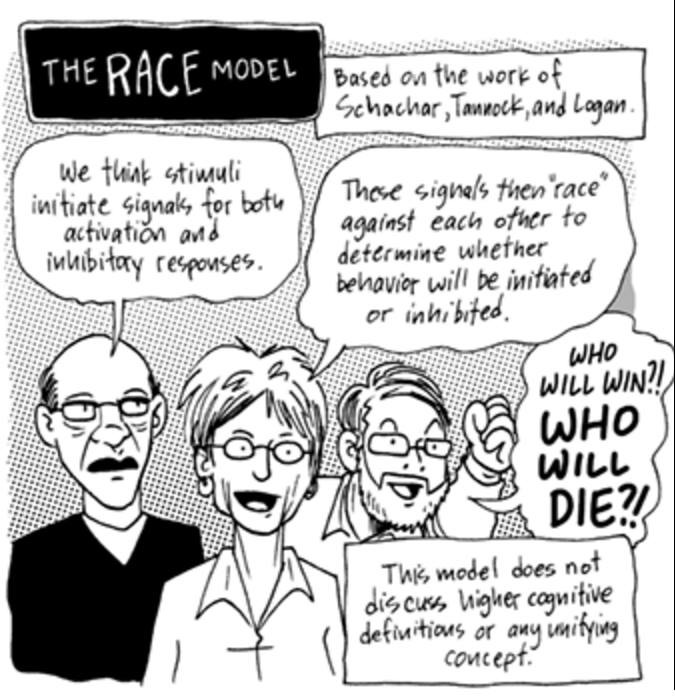
 The stop-signal paradigm is a useful tool for investigating response inhibition. Gordon Logan, Frederick Verbruggen, and Michael Stevens have developed a free program, called STOP-IT, for running the stop-signal task. STOP-IT can be installed on computers running Windows 2000/XP and it is available under the GNU General Public License.


.jpg)